Thursday, October 28, 2010
Students to make Inter board's policies

Monday, October 11, 2010
Rage against the social evils – Pakistani music fights back
Henry Wadsworth Longfellow defines music as the universal language of mankind. What expressed through music is the musician’s inside or around. Love, betray, patriotism and joy are emotions that are usually expressed through tunes. Hate, corruption, prejudice, war, riots, conflict, extremism and terrorism are the bad sides of society and unfortunately we, the Pakistanis, have witnessed them badly since our country’s inception. This is the time when one is concerned about his/her society and this is where the music depicts it too.

As music is simply human emotion, social issues music’s history is old too. Rage against the machine (An American band of 1990s) presented fiercely polemical music with heavy metal instrumentation. One of the greatest names of western music Michael Jackson also raised voice against prejudice.
In
Talking about Najam Sheraz, his song “Yeh baat kisay maloom nahin”(1996) is a curious song. The song highlights the deprived part of the society and how the “sarmaye ke bhookay sher” (capitalists / politicians) exploit them. This song was censored on national TV and the reason was its being against establishment. “Sona chahta hoon” (1

995) is a song where Najam sheraz wildly cried for Kashmiris. The one-of-its-kind screaming song was banned on national radio (reason: the lyrics and vocal performance was too wild for the youth).
Jazba, a band appeared in early 90s, were also one of the few musicians who raised voice against Indian aggression in
Another band likely to be mentioned here is Strings who have just came back with Atif Aslam in “Ab khud kuch karma parega”. It is a messag

e to Pakistanis to standup against terrorism and fear. Earlier, they’ve also done “Berut”, a song for Gaaza.
Karavan, the rock band of masters, also set a benchmark in social issues. ‘Rakh aas’ and ‘Yeh zindagi hai’ are the band’s social thoughts.
How can one forget the lahori band Entity Paradigm (EP) here? Kahan hai tu and Humain aazma represent youth and motivation while the aggressive song “Fitrat” questions the elite for exploiting people “Bol qabeel tu chahta hai
kya, uska haq ya ke uski dua?”… the lyrics are amazing specially at a place where he says “Kaghaz k tukray (money) to dikha jinhain jor ke tu bana khuda”. Tremendous stuff!!!

In 2007, when  . This is where a young band ‘Laal’ raised up and followed revolutionary poems of Habib Jalib and Faiz Ahmad Faiz. ‘Meine us se yeh kaha’ and ‘Umeed-e-Seher’ are inspiring enough.

Money is everything, says the band Azal in song ‘Aisi Taisi’. The song with excellent music arrangement and strong lyrics depicts society running after money. It is voice of a rebel.
Socio-political satire can’t be unnoticed when talking about social issues. Shehzad Roy tops the list with ‘Laga reh’ and ‘Qismat apne hath main’. His lyrics are always strong  and thought-provoking and through satire, he has successfully delivered his wakeup call. As a social activist,
A lot of other musicians have also attempted music on social issues but the ones mentioned above were the milestones in the industry. Music surely reflects what’s around in our society and Pakistani music does it well.
- Jibran
Monday, August 2, 2010
Dedicated to Air Blue crashed flight passengers
I look and stare down below
Something is wrong people are crying
I wondered if anyone was dying
I never saw anyone steering the plane
I wonder if the captain has gone insane
The plane is moving downward from the sky
I prayed to God and begged Him not to let me die
Everyones out of their seats yelling and screaming
I wonder if anyone here is a demon
I looked out the window,
we're close to being dead
I wish this was a dream and I could wakeup in my bed
But it wasn't a dream it was real life
I wish I had my really sharp knife
Then I could put this all to an end,
and I wouldn't have to take the time to mend
Soon enough we crash on hill
After that I couldn't hear a single sound
Everyone was dead, and so was I
I never wanted it to end like this, "I never wanted to die"

Friday, June 25, 2010
Novartis BioCamp - A milestone
The 2-days BioCamp is an effort to bring young, talented and energetic students from diverse faculties and different universities closer to the field. 26 Students and researchers from different cities of Pakistan were evaluated and selected to participate in this exciting event. The participating universities were University of Karachi, HEJ institute, Baqai University, Ziauddin University, Hamdard University, University of Sindh, University of Punjab (Lahore) and Islamia University (Bahawalpur). On the other hand, two participants from media were also invited as participants’ i.e (Jibran T. Siddiqui, Health Reporter, News1 TV and Ovais Ahmed, Dawn News TV). Thus, Novartis succeeded to make a diversified combinatio
 n of individuals from the areas of Pharmacy, Drug research, Molecular research and Health Journalism.
As a Health Reporter, I was a bit confused when called for BioCamp as I’m not a medical student. I had no idea if I would be able to understand the terms and discussions about an advanced discipline as Biotechnology. I was fortunate to have students like Muffrah, Shahid, Shahrukh and Hina in my group who belonged to different universities and had different specialities and skills. Throughout the conference, we worked
 together. Preparing and presenting the marketing plan about an Alzheimer Test was a challenging task and we together accomplished to a satisfactory performance. Thank you guys! All the presenters did very well and their marketing plans (prepared in 90 minutes only) were excellent from any point of view. This will surely help them in future.
The BioCamp participants were very fortunate to be accompanied by the distinguished experts from various fields. Speakers like Dr. Iqbal Choudhry (HEJ Institute), Dr. Saifullah Khan (HEJ Institute), M. Khalid Yousuf (Novartis), Dr. Ahson Siddiqi
 (Novartis) and Dr. Tasneem Farzana (NIBD) proved to be the best guiding stars. Moreover, sessions by Mr. Merajuddin (HR, Novartis) and Urooj Mazhar (School of Leadership), other feathers in the cap. Prof. Masood Hameed Khan (VC, Dow University of Health Sciences) spoke about BioTech at the inaugural ceremony and opened new doors of information to the students. Undoubtedly, the eminent speakers inspired the participants to create waves.
One of the most interesting parts of the BioCamp was the ‘Cultural evening’. All the participants were dressed up in eastern attire and performed one by one on the stage. These performances included Singing, speeches, poetry and dance. It was surprising the see the students performing so confidently on the stage. Maryah, Munazza, Omair and Shahrukh astonished me by their stage confidence, thumbs up! Ahmed Saleh attempted ‘Laal meri patt’ where the boys danced to the beats. My contribution for the night was an unplugged performance of Imik’s mellow song ‘Piya’. Some participants entertained the audience by humorous poetries that made everyone laugh out lou
 d. Novartis family also delivered some exciting performances including the classic ‘Kabhi to tumko yaad ayengay’ by Dr. Ahson Siddiqi and a song performed by wife of a Novartis family member. Moiz’s stand-up comedy also brought smiles and refreshed the evening. Ovais Ahmed from Dawn presented a piece of poetry by Faiz and an extract from Pitras Bukhari with his skilled voice overs. Well done
The post-cultural evening gathering was the craziest moment. The participants sang and danced like no one watched J
What I learned from BioCamp was working in a team of different minds and utilizing their respective skills to achieve goals. On the other hand, BioCamp also introduced us to the modern trends of pharmaceuticals and biotechnology. Working together, the participants discovered their skills and talents and analyzed themselves in the context of SWOT (Strength, Weakness, Opportunities and Threats).
As a participant, I’m very thankful to Novartis who considered media as regular participant. This will help in bringing the three pillars Academia, Industry and Media closer and forming an effective triangle that works for social development.
I would like to thank people without whom this mega-event was not possible. Mr. Shabuddin, Mr. Merajddun, Mr. Khalid Yousuf and others from Novartis. Dr. Ahson Siddiqi remained as the guiding star and the prime mentor throughout the conference. He was physically and mentally present at each and every moment of BioCamp. Mr. Zia Anwer put tremendous effort in organizing the event while Ms. Tania Anjum proved herself a silent storm. I express special thanks for Zia and Tania for being dynamic, supportive and humble at the situations.
The two-day conference earned us great friends. As Ahmed Saleh said that the saddest part is that the night we turned great friends followed the day we left. Thank you Ovais for being a convenient room mate, Muffrah and Omair for being there at every moment, Hanna for bugging around, Ahmed Saleh, Maryah, Nayel, Munir, Sundus and Hanna for the late night fun and Munazza, Ali, Sajid, Kashif, Shahrukh, Shahid, Rakhshanda, Ayesha, Hina, Rabia and others for being there as shining stars. Wish you all best of luck for the future!

Congratulations to Ali Uzair and Hann`a Iqbal, who got selected for the International BioCamp in Basel, Switzerland. Best of luck mates =)
The Local BioCamp 2010 will remain as an unforgettable experience of my career. I hope the event stays as a milestone in our life and we implement the learning for a bright future.
- Jibran T. Siddiqui
Tuesday, May 25, 2010
Achievement: Pakistani students made a terrific car
 3,790,994 cars in 2009 while Japan and USA are next with 7,934,516 and 5,711,823 respectively. Unfortunately, Pakistan has still not appeared in this sector. Is lack of talent our problem? No.
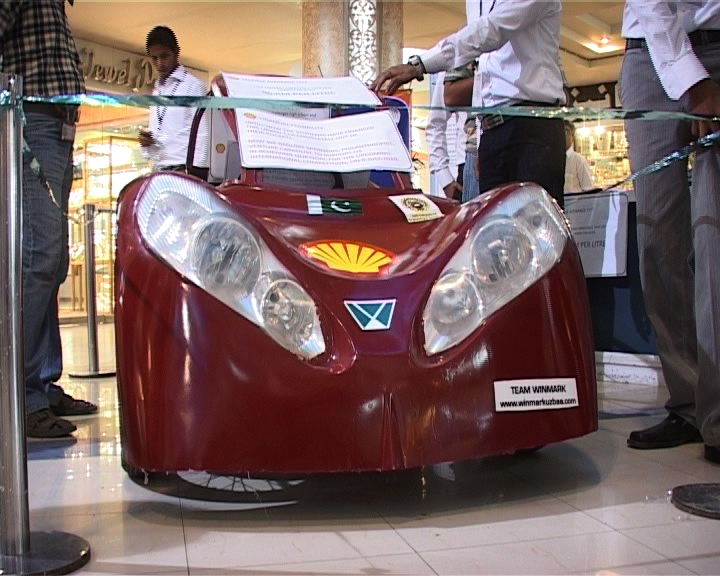
Recently, a group of students from NED University of Engineering and Technology have manufactured a model car that gives 80 kilometers per liter petrol. These ambitious and hardworking students belong to Mechanical and Electrical Engineering departments and the team calls itself ‘WINMARK’.
 The shining, attractive and compact car can grab anyone’s attention.
Winmark has designed the car to participate in the upcoming global competition by Shell in Malaysia which invites the students worldwide to design car with best mileage.
Speaking to Common Room, the team leader Haris said that all the cost has been contributed by the students themselves. They’ve worked day and night to bring the car from design to execution. “No organization has contacted us for full sponsorship yet. We’re students and we cannot
 bear the full expenses of manufacturing and especially transporting the car to Malaysia for competition.” said Haris. He said that they’re representing Pakistan in a global competition and therefore need financial assistance for this.
Winmark member Ashraf says, “We’ve worked very hard to win and Inshallah if we do, we have plans to launch the car commercially. The car is economical, eye-
 catching and safe so it would be an ideal car for anyone. Its body is made of fiber so its safe it meets any accident. We’ll proud if we launch a car from Pakistan.
Although these determined students have no financial assistance, they have talent, skill and above all enthusiasm to touch skies. Common Room wishes them good luck!

Friday, May 21, 2010

Facebook & the unfortunate King
The recent blasphemy issue of Facebook reminded me of that state’s story. An evil group on Facebook launched an event and invited the artists worldwide to draw sketches of Prophet Mohammad (PBUH) which is a very disgusting act against the Muslims. Throughout the world, Muslims are protesting while Pakistan is leading the front. For this evil act, Lahore High court has banned Facebook in Pakist
 an for indefinite period. Following the order, websites like Youtube and Wikipedia are also banned by Pakistan Telecommunication Authority (PTA) for “growing sacrilegious content”. It may seem emotionally correct but let’s have a look rationally.
According to an estimate, Pakistan has more than 25 million internet users. In this 25 million, majority is of students, journalists, doctors, bureaucrats, writers, researchers and other professionals. Wikipedia is one of the prime sources of information for students, journalists, researchers and others and over 75% of internet users log on to Wikipedia for information. Be it an academic assignment, news or an article, Wikipedia is one of the most reliable information websites. Wikipedia provides the most accurate and detailed information even when you search a less-known personality of your country. The website tells the background, career, date of birth and even place of birth about a personality. The website is highly trusted and the information is published on unprejudiced basis.
Now I come to the point. When I needed to search the history and backgrounds of the famous personalities like Nazia Hassan, Aitizaz Ahsan and Shahid Afridi, no Pakistani website provided me detailed information but Wikipedia. There is no complete encyclopedia website in Pakistan that could serve the Pakistanis. Banning Wikipedia has created a critical situation for students and professionals who needed information. We’re so dependant on the others that we’ve never made any information and video portals. In this situation, is it correct to ban such websites?
As I said, the present situation reminds me of that unfortunate State that was destroyed by her neighbors. Same as the king did, the Government started with banning Facebook, then Youtube and Wikipedia. There are thousands of other ways that these anti-Muslim elements could use. Let’s see that the government will ban Google, hotmail, yahoo and other websites too. In the end, internet will be blocked in Pakistan and Pakistan will move back to decades. The evil elements will also try to spread their unethical messages through TV, so the government will first ban the channels and then the TV too. I also expect the government to ban all the art schools in the country so that nobody could draw Prophet Mohammad (PBUH)’s sketch. Déjà vu it is.
Is there some other way too? Yes. We have proved ourselves true Muslim nation who don’t compromise on our religion but is only banning such websites a solution? There are thousands of other channels from where the blasphemy messages can be reached so there’s no reason of banning the websites. On the other hand, we have to step ahead and make information portals of our own. In this way, banning won’t even affect us.
Anyway, we have to keep protesting about such disgusting acts but rationale also matters. We have to find the ‘Solution’ instead of what the king did to his state.


